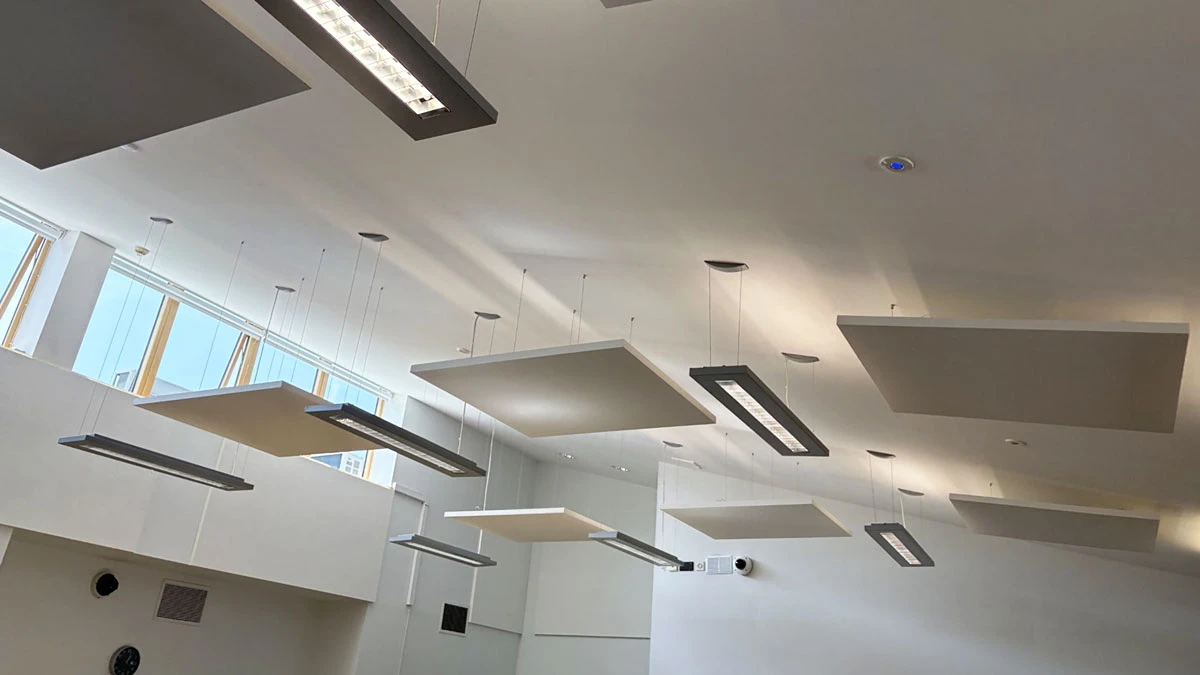
Improving acoustic clarity in a specialist healthcare environment


With an acoustic rating of 43db, DORMA Moveo Glass was chosen as the most suitable solution, namely because it offered such a perfect balance between privacy (which is achieved with the turn of a key with electronically operated integral blinds) and the maximisation of light and space when the blinds are open.
Bradshaw Gass & Hope LLP
Whitfield & Brown (Developments) Ltd
Being able to offer the local community a wide range of activities is underpinned by the church’s new movable partitioning wall.
Working with contractor, Whitfield & Brown (Developments) Ltd, and architect, Bradshaw Gass & Hope LLP, Style was appointed to deliver flexible space so that the church could host a number of activities and events concurrently, or open the area out into one expansive space.
With an acoustic rating of 43db, DORMA Moveo Glass was chosen as the most suitable solution, namely because it offered such a perfect balance between privacy (which is achieved with the turn of a key with electronically operated integral blinds) and the maximisation of light and space when the blinds are open.
Separating the cafe and bookshop area, which is also used as an ‘activity space’, the double glazed, 6mm toughened glass gives a modern look to this beautiful building. According to Andy Gibson, Style’s director for the North, Moveo Glass was also specified with consideration for the people who were going to be using it.
“Moveo was chosen as it is lightweight and offers semi-automatic operation, which is a big advantage for the older members of the congregation,” said Andy.
“This means it can be opened and closed effortlessly, is very smooth to slide into position and the semi-automatic seals mean it fastens into place without any need to turn heavy handles.”
“We have a great deal of experience of working with churches and this is an outstanding solution that is always received with real acclaim.”
Talk to us about your acoustic goals — we’ll help you design a solution that sounds as good as it looks.



2026 © Style Group
HBN 00-09 sets out these surface characteristics because unsealed joints are a recognised place for moisture and micro-organisms to collect. A genuinely joint-free edge is designed to address that specific detail.
This is a surface and edge specification, not a clinical claim. Zero-joint technology has not been evaluated or certified by NHS England, and does not claim to reduce infection rates.
Food-service and guest-facing areas are typically inspected under hygiene and housekeeping standards that look closely at surfaces and joints. A seamless, moisture-resistant edge is designed with exactly that kind of scrutiny in mind.
Every one of these sectors shares the same underlying surface problem: a bonded-strip edge is a seam, and a seam is a place where dirt, moisture or wear can concentrate in a way a continuous surface can't. Zero-joint technology addresses that one structural detail across offices, schools, healthcare and hospitality settings alike — one construction detail, one shared weak point removed, four sectors that each care about it for their own reasons.
Fill in the form below and we’ll get back to you within one working day.
Fill in the form below and we’ll get back to you within one working day.
Fill in the form below and we'll get back to you as quickly as we can.
