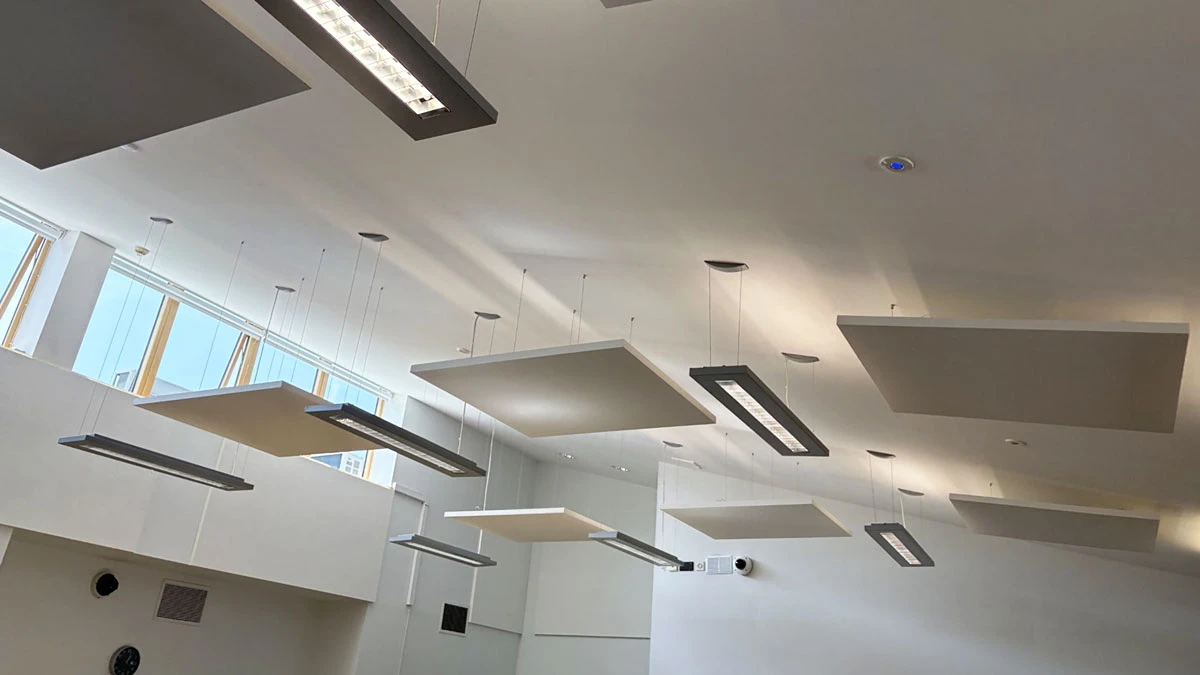
Improving acoustic clarity in a specialist healthcare environment


To achieve this Style chose the semi-automatic DORMA Variflex moveable wall system, but included a ‘horizontal panel joint’ to achieve the required height. This effectively meant 2 sets of panels being attached on top of each other to provide superb acoustic integrity of 55dB in a very large room.
At the Church of Jesus Christ of Latter-day Saints in Chorley, the building is used for a wide multitude of activities, ranging from worship to sports.
Working with architect Frith Williams and contractor BE Boys, Style was asked to sub-divide the sports hall, characterised by its very high ceiling.
To achieve this Style chose the semi-automatic DORMA Variflex moveable wall system, but included a ‘horizontal panel joint’ to achieve the required height. This effectively meant 2 sets of panels being attached on top of each other to provide superb acoustic integrity of 55dB in a very large room.
“This room has very varied use,” said Andy Gibson, Style’s director for the north. “This can vary from worship to basketball, which is why the space needs to be flexible to adapt quickly to its use.
“Variflex is the ideal operable wall for this situation as, not only, can it accommodate high ceilings and difficult room configurations, the panels are also manufactured separately to the frame which means they are interchangeable and easy to swap if one is damaged or scuffed, or the interior design of a room changes later on.”
Style is the exclusive UK partner to DORMA, is 9 times winner of the coveted FIS Gold Contractors award, and has extensive experience of working with churches.
“We have built up a strong reputation in the religious sector,” said Andy, “and we have a wide range of moveable wall systems, including glazed partitioning walls, which have been very popular over the years.
“If any church is looking to use its space more flexibly, we have a wonderful portfolio of solutions to meet all requirements, room designs and budgets.”
Talk to us about your acoustic goals — we’ll help you design a solution that sounds as good as it looks.



2026 © Style Group
HBN 00-09 sets out these surface characteristics because unsealed joints are a recognised place for moisture and micro-organisms to collect. A genuinely joint-free edge is designed to address that specific detail.
This is a surface and edge specification, not a clinical claim. Zero-joint technology has not been evaluated or certified by NHS England, and does not claim to reduce infection rates.
Food-service and guest-facing areas are typically inspected under hygiene and housekeeping standards that look closely at surfaces and joints. A seamless, moisture-resistant edge is designed with exactly that kind of scrutiny in mind.
Every one of these sectors shares the same underlying surface problem: a bonded-strip edge is a seam, and a seam is a place where dirt, moisture or wear can concentrate in a way a continuous surface can't. Zero-joint technology addresses that one structural detail across offices, schools, healthcare and hospitality settings alike — one construction detail, one shared weak point removed, four sectors that each care about it for their own reasons.
Fill in the form below and we’ll get back to you within one working day.
Fill in the form below and we’ll get back to you within one working day.
Fill in the form below and we'll get back to you as quickly as we can.
