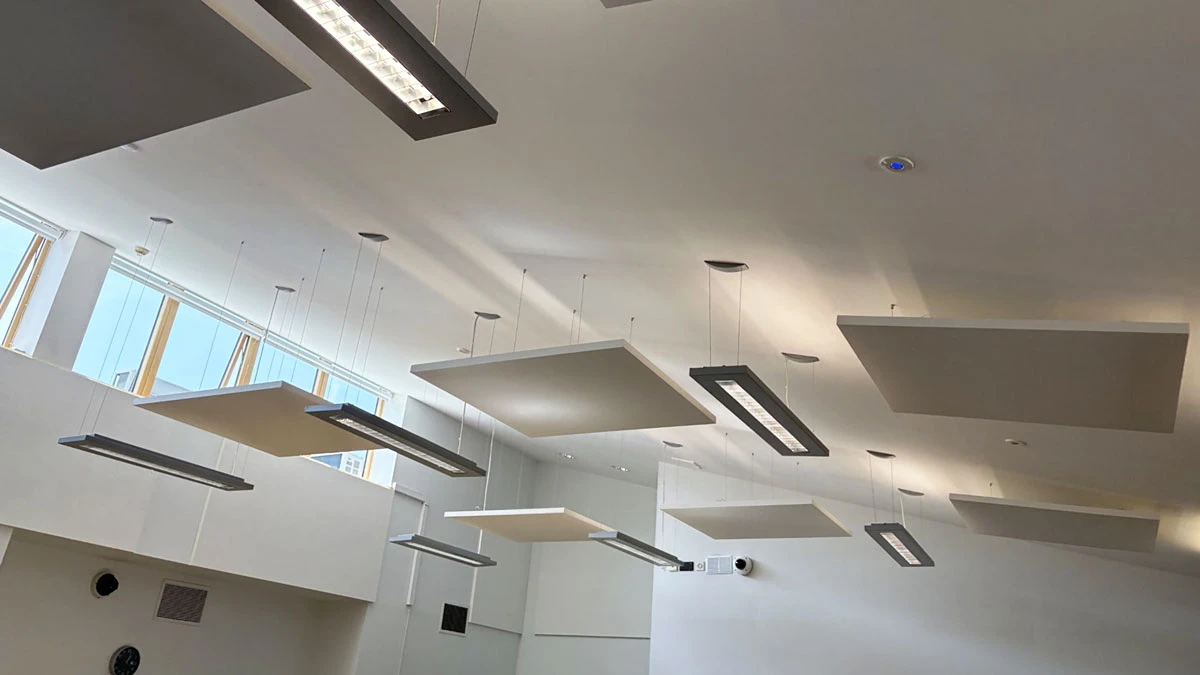
Improving acoustic clarity in a specialist healthcare environment


Downing Place church is an open and inclusive church in the centre of Cambridge that welcomes all. In 2018 it closed its doors to undergo a significant redevelopment and, following the challenges of Covid lockdowns, it re-opened in April 2021. Working with Arch Angel architects, and Coulson Builders, Style was specified to create a moveable […]
Downing Place church is an open and inclusive church in the centre of Cambridge that welcomes all.
In 2018 it closed its doors to undergo a significant redevelopment and, following the challenges of Covid lockdowns, it re-opened in April 2021.
Working with Arch Angel architects, and Coulson Builders, Style was specified to create a moveable divide between the main church and the meeting space at the rear.
To enable plenty of light to flow through the church, a Dorma Huppe Variflex Glass moveable wall system was installed with a pass door for ease of access.
The wall also has automatic blinds which means complete privacy is available when needed, and the impressive 50dB acoustic rating of the Variflex means that concurrent gatherings and meetings can take place either side of the wall undisturbed.
“This is a highly practical and stylish glass moveable wall which is ideal for churches like Downing Place URC,” said Steve Williams, sales director for Style Midlands.
“With semi-automatic operation, it is effortless to open and close making it simple for anyone to change the use of the space at a moment’s notice, with the acoustic seals moving into place to apply the right pressure and maximise the acoustic barrier.
“With churches being at the heart of all communities, we see a lot of demand for moveable, folding and partitioning walls as this enables the space to be used for a multitude of activities each and every day. It also opens up more opportunities for room hire to create additional income.”
Style is the exclusive UK partner to Dorma Huppe, Skyfold and SWG, offering a complete range of manual, semi-automatic and fully automatic solutions for all requirements and budgets.
For more case studies from the religious sector
please visit our case studies page
Talk to us about your acoustic goals — we’ll help you design a solution that sounds as good as it looks.



2026 © Style Group
HBN 00-09 sets out these surface characteristics because unsealed joints are a recognised place for moisture and micro-organisms to collect. A genuinely joint-free edge is designed to address that specific detail.
This is a surface and edge specification, not a clinical claim. Zero-joint technology has not been evaluated or certified by NHS England, and does not claim to reduce infection rates.
Food-service and guest-facing areas are typically inspected under hygiene and housekeeping standards that look closely at surfaces and joints. A seamless, moisture-resistant edge is designed with exactly that kind of scrutiny in mind.
Every one of these sectors shares the same underlying surface problem: a bonded-strip edge is a seam, and a seam is a place where dirt, moisture or wear can concentrate in a way a continuous surface can't. Zero-joint technology addresses that one structural detail across offices, schools, healthcare and hospitality settings alike — one construction detail, one shared weak point removed, four sectors that each care about it for their own reasons.
Fill in the form below and we’ll get back to you within one working day.
Fill in the form below and we’ll get back to you within one working day.
Fill in the form below and we'll get back to you as quickly as we can.
