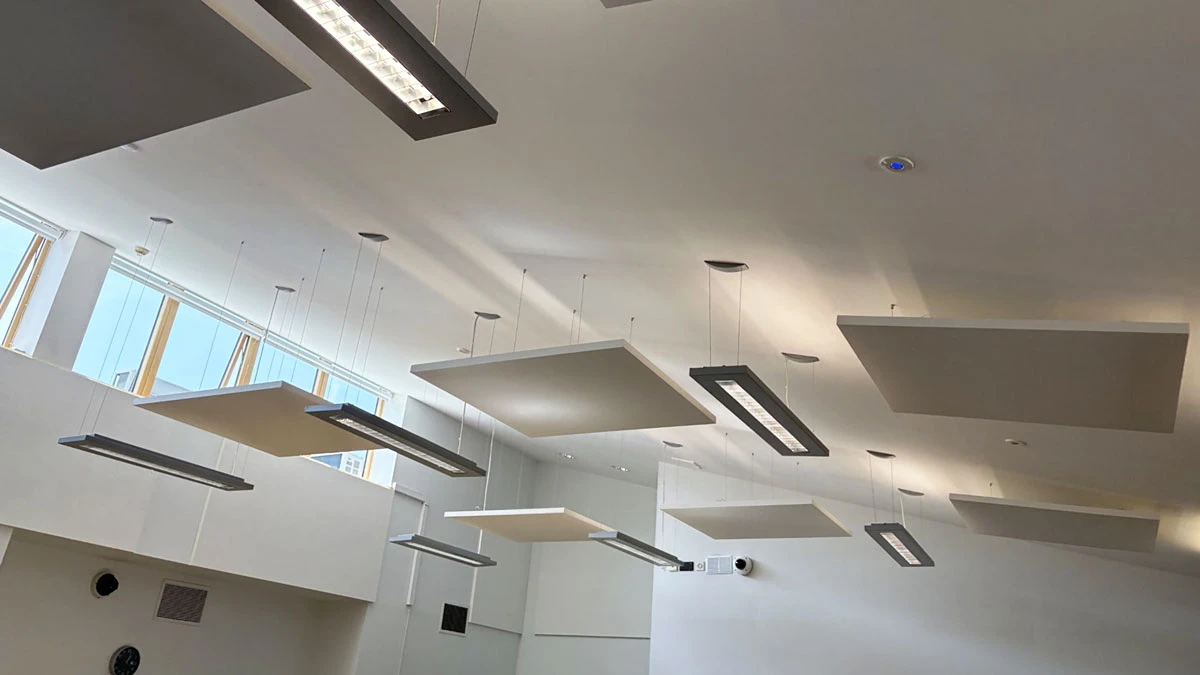
Improving acoustic clarity in a specialist healthcare environment


The Engine Shed is Scotland’s dedicated building conservation centre, based in Stirling. It serves as a central hub for building and conservation professionals and the general public who can explore the stories of the structures all around them at this unique free-to-visit centre.
Skyfold
Scotland
Reiach & Hall
ESH Border
The Engine Shed is Scotland’s dedicated building conservation centre, based in Stirling. It serves as a central hub for building and conservation professionals and the general public who can explore the stories of the structures all around them at this unique free-to-visit centre.
Working with contractor, ESH Border and architect Reiach & Hall, Style was specified to quickly divide a tiered theatre with a Skyfold operable wall. Skyfold is the hugely innovative, fully automatic, vertically rising moveable wall operated by the push of a button.
It glides effortlessly and quickly into place enabling space to be divided, or opened up, with ease.
“We were thrilled to be asked to work on this project,” said David Louden, Style’s director for Scotland, “because as a company based just up the road in Tillicoultry, we are well aware of how very special and unique this visitor centre is for the Scottish people and tourists visiting the area.
“Skyfold is a perfect solution because it takes up no floor space whatsoever when open, based on Skyfold’s principle of going vertical.
“In fact, it causes a bit of ‘wow factor’ at the Engine Shed when visitors see it glide into position, sealing off the room with phenomenal acoustics. Once inside, you can’t hear what’s going on in the rest of the centre giving real privacy for talks, teaching and briefings.”
In addition to the Skyfold, Style also installed a semi-automatic DORMA solid moveable wall and a semi-automatic DORMA double-glazed moveable wall at the Engine Shed, making this a very prestigious project.
Style is the exclusive UK partner to Skyfold and DORMA, and has installed over 200 Skyfold walls across the UK in a whole range of market sectors including company boardrooms, universities, colleges and schools, local authorities, hotels and conference centres.
Talk to us about your acoustic goals — we’ll help you design a solution that sounds as good as it looks.



2026 © Style Group
HBN 00-09 sets out these surface characteristics because unsealed joints are a recognised place for moisture and micro-organisms to collect. A genuinely joint-free edge is designed to address that specific detail.
This is a surface and edge specification, not a clinical claim. Zero-joint technology has not been evaluated or certified by NHS England, and does not claim to reduce infection rates.
Food-service and guest-facing areas are typically inspected under hygiene and housekeeping standards that look closely at surfaces and joints. A seamless, moisture-resistant edge is designed with exactly that kind of scrutiny in mind.
Every one of these sectors shares the same underlying surface problem: a bonded-strip edge is a seam, and a seam is a place where dirt, moisture or wear can concentrate in a way a continuous surface can't. Zero-joint technology addresses that one structural detail across offices, schools, healthcare and hospitality settings alike — one construction detail, one shared weak point removed, four sectors that each care about it for their own reasons.
Fill in the form below and we’ll get back to you within one working day.
Fill in the form below and we’ll get back to you within one working day.
Fill in the form below and we'll get back to you as quickly as we can.
