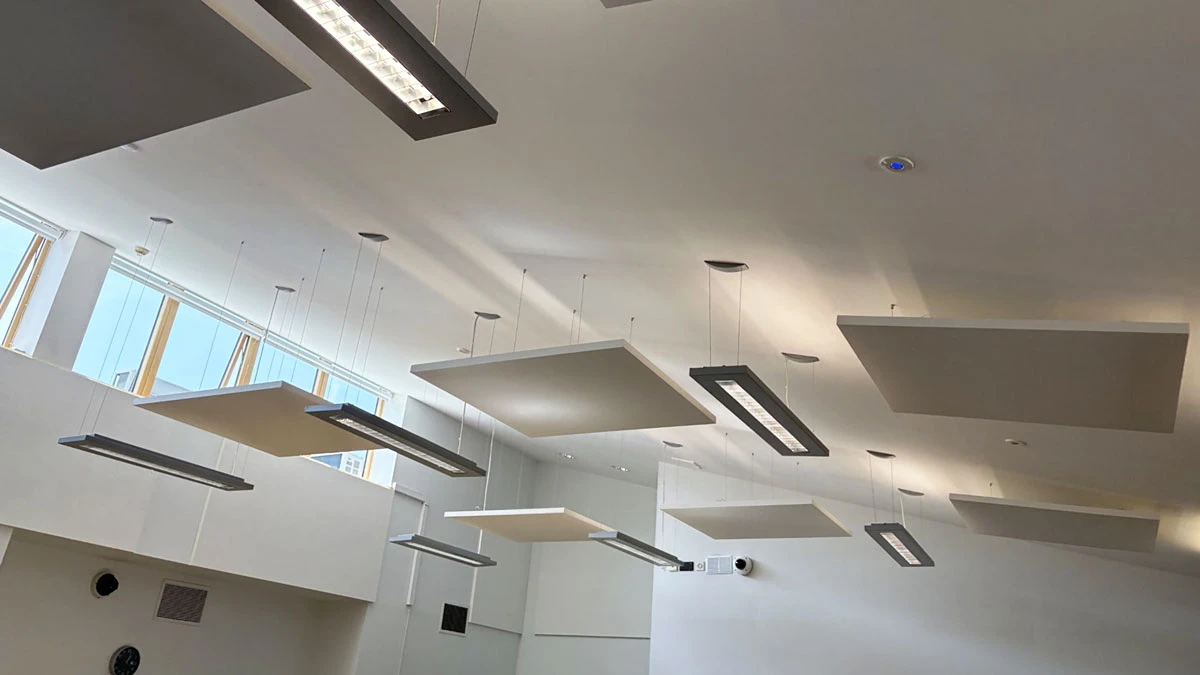
Improving acoustic clarity in a specialist healthcare environment


Bristol Airport is the ninth busiest airport in the United Kingdom, handling over 7.6 million passengers in 2016. Airlines with operating bases at the airport include EasyJet, Ryanair, Thomas Cook, Thomson Airways and BMI Regional.
Bristol Airport is the ninth busiest airport in the United Kingdom, handling over 7.6 million passengers in 2016. Airlines with operating bases at the airport include EasyJet, Ryanair, Thomas Cook, Thomson Airways and BMI Regional.
During the extension of the western terminal, Style worked with architect McAllister Armstrong & Partners, and main contractor Balfour Beatty to provide the very best in space management.
The aim was to make the baggage reclaim area as flexible as possible enabling Bristol Airport to best manage peaks in demand. This was achieved through moveable wall solutions that gave airport staff the ability to increase the baggage reclaim areas by an extra one or two rooms during the busy periods, which is essential for the smooth flow of passengers coming into the arrivals area.
The operable wall combined DORMA Moveo solid panels with DORMA Moveo Glass, both with 50dB Rw acoustics and Comfortronic semi-automatic seals.
Julian Sargent, Style’s group managing director explains, “Combining glass and solid panels was important for security reasons, because it provides instant visual access to each divided area.
“Aesthetically, it also allows more light to filter through the room and gives a feeling of space even when the area is segregated.
“The semi-automatic operation of the walls is also an advantage, as it assists their swift opening and closing in an incredibly busy, high secure airport environment.
“However, most importantly, by opening the walls at peak times means the airport instantly boosts its capacity, and by closing them during quieter periods means passengers are restricted to the parts of the airport they need to be in, leading to easier management of people by airport staff.”
Talk to us about your acoustic goals — we’ll help you design a solution that sounds as good as it looks.



2026 © Style Group
HBN 00-09 sets out these surface characteristics because unsealed joints are a recognised place for moisture and micro-organisms to collect. A genuinely joint-free edge is designed to address that specific detail.
This is a surface and edge specification, not a clinical claim. Zero-joint technology has not been evaluated or certified by NHS England, and does not claim to reduce infection rates.
Food-service and guest-facing areas are typically inspected under hygiene and housekeeping standards that look closely at surfaces and joints. A seamless, moisture-resistant edge is designed with exactly that kind of scrutiny in mind.
Every one of these sectors shares the same underlying surface problem: a bonded-strip edge is a seam, and a seam is a place where dirt, moisture or wear can concentrate in a way a continuous surface can't. Zero-joint technology addresses that one structural detail across offices, schools, healthcare and hospitality settings alike — one construction detail, one shared weak point removed, four sectors that each care about it for their own reasons.
Fill in the form below and we’ll get back to you within one working day.
Fill in the form below and we’ll get back to you within one working day.
Fill in the form below and we'll get back to you as quickly as we can.
