Improving acoustic clarity in a specialist healthcare environment


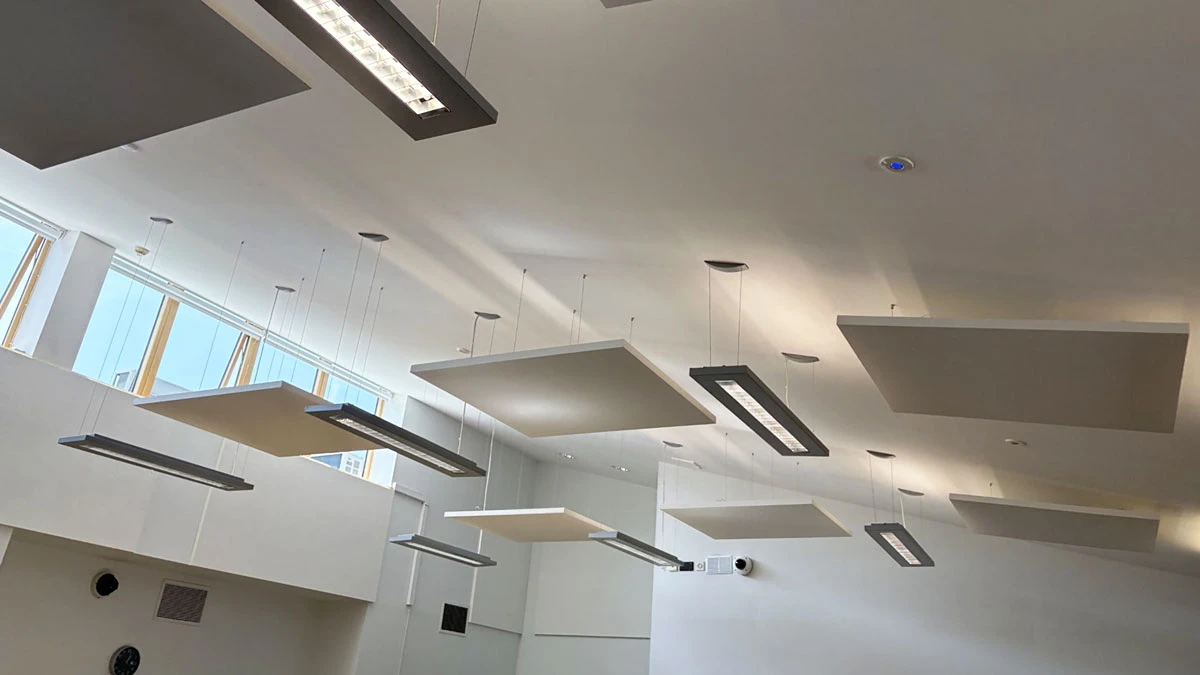
We installed Ecophon acoustic panels at the William Quarrier Scottish Epilepsy Centre, cutting noise and reverberation in a busy dining room. The washable, healthcare-grade solution improved sound clarity for clinical video recordings, helping the Neurophysiology team review patient footage more effectively.
Style Scotland provides acoustic panels healthcare teams can rely on, and was approached by the William Quarrier Scottish Epilepsy Centre to address excessive noise and reverberation within its dining room. Find out more via Style Scotland.
The centre provides residential care for patients with epilepsy, with cameras and microphones used to monitor and record potential seizure activity. However, the poor acoustic environment made it difficult for the Neurophysiology team to capture clear audio recordings from the room.
Working within the requirements of a public health environment, the acoustic solution needed to provide effective sound absorption while also incorporating fully washable finishes. Style Scotland proposed a combination of Ecophon Solo Akutex HS Raft acoustic panels, providing a practical and aesthetically appropriate solution that complemented the existing interior while remaining within the project budget.
The ceiling installation comprised 12 square 1,200 x 1,200 mm rafts, strategically positioned to help absorb sound and reduce reverberation within the dining environment. A further six 1,200 x 2,400 mm rectangular panels were resized and installed across the walls, extending the acoustic treatment throughout the room while creating a cohesive visual finish.
The Ecophon Solo Akutex HS system was particularly well suited to the project, offering effective sound absorption alongside a durable, fully washable surface appropriate for a healthcare environment.
The installation was carefully managed to minimise disruption to the operational building, with the installation team working considerately around staff and residents.
Following completion, the acoustic improvements have made a significant difference to the clarity of recorded patient video, helping the Neurophysiology team review footage more effectively.
“I’m really happy with the job and it’s making a big difference when reviewing patient video.”
The centre also commented:
“We are delighted with the work carried out by yourselves. The works caused minimal disruption, and the installation team were very considerate of the building being operational during the install works.”
See more of our work in case studies.
Talk to us about your acoustic goals — we’ll help you design a solution that sounds as good as it looks.



2026 © Style Group
HBN 00-09 sets out these surface characteristics because unsealed joints are a recognised place for moisture and micro-organisms to collect. A genuinely joint-free edge is designed to address that specific detail.
This is a surface and edge specification, not a clinical claim. Zero-joint technology has not been evaluated or certified by NHS England, and does not claim to reduce infection rates.
Food-service and guest-facing areas are typically inspected under hygiene and housekeeping standards that look closely at surfaces and joints. A seamless, moisture-resistant edge is designed with exactly that kind of scrutiny in mind.
Every one of these sectors shares the same underlying surface problem: a bonded-strip edge is a seam, and a seam is a place where dirt, moisture or wear can concentrate in a way a continuous surface can't. Zero-joint technology addresses that one structural detail across offices, schools, healthcare and hospitality settings alike — one construction detail, one shared weak point removed, four sectors that each care about it for their own reasons.
Fill in the form below and we’ll get back to you within one working day.
Fill in the form below and we’ll get back to you within one working day.
Fill in the form below and we'll get back to you as quickly as we can.
