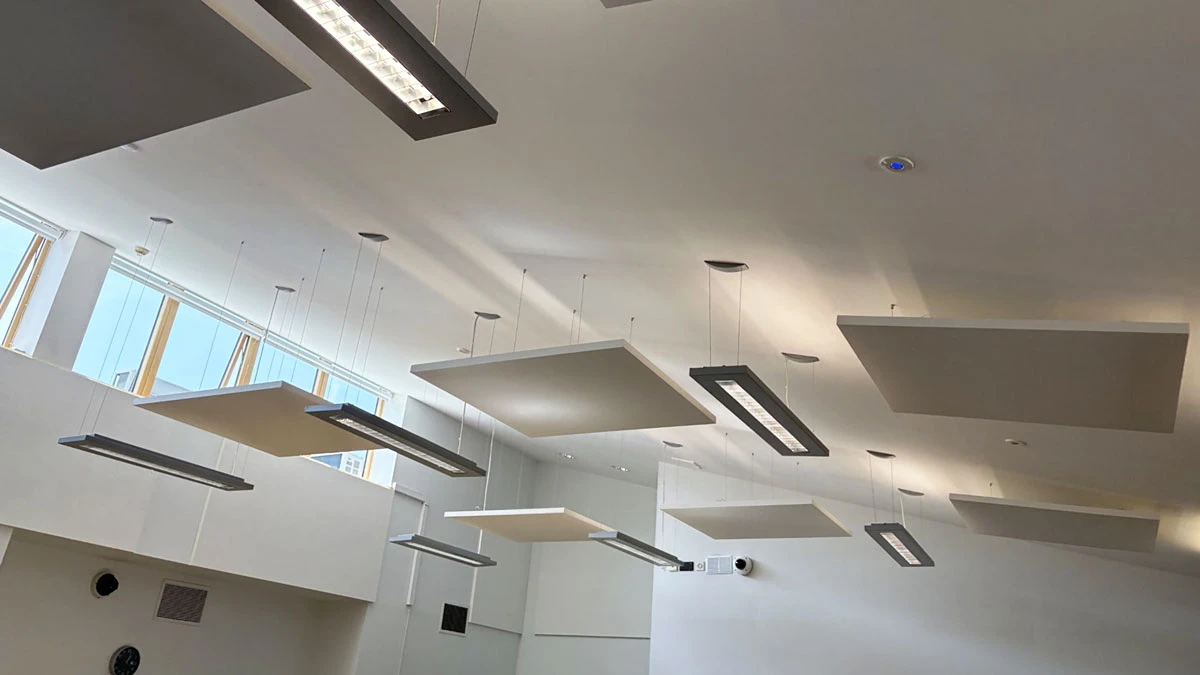
Improving acoustic clarity in a specialist healthcare environment


An important feature was to make the space flexible – particularly as the building hosts such a multitude of activities throughout every day and evening. Style was appointed by Faulkner Brown Architects and Contractor Bam to provide a solution which could offer small breakout rooms which opened into larger areas for meetings and other gatherings. […]
An important feature was to make the space flexible – particularly as the building hosts such a multitude of activities throughout every day and evening.
Style was appointed by Faulkner Brown Architects and Contractor Bam to provide a solution which could offer small breakout rooms which opened into larger areas for meetings and other gatherings. Style was also given the challenge of partitioning off the bar whilst not in use – which was previously housed behind shutters.
“The bar posed an interesting challenge because it is curved,” said Andy Gibson, Style’s director for the North. “We therefore decided on a faceted track system to give a rounded look to the wall when the bar was closed.“And because we were working with an old building there were a number of challenges with sloped ceilings and uneven floors and walls.
“We therefore chose Dorma Variflex because of its wide choice of elements and stacking/parking arrangements. It is also extremely flexible even in the case of complicated room proportions, making it ideal for this project.”
The final solution enables the bar area to be neatly closed off when not in use, and for the breakout areas to be sub-divided, or opened up, with ease so that they can accommodate a wide range of student activities, offering enough privacy for noisy activities to reside next to quieter ones thanks to Variflex’s acoustic qualities and the attention to detail by Style during the installation.
Talk to us about your acoustic goals — we’ll help you design a solution that sounds as good as it looks.



2026 © Style Group
HBN 00-09 sets out these surface characteristics because unsealed joints are a recognised place for moisture and micro-organisms to collect. A genuinely joint-free edge is designed to address that specific detail.
This is a surface and edge specification, not a clinical claim. Zero-joint technology has not been evaluated or certified by NHS England, and does not claim to reduce infection rates.
Food-service and guest-facing areas are typically inspected under hygiene and housekeeping standards that look closely at surfaces and joints. A seamless, moisture-resistant edge is designed with exactly that kind of scrutiny in mind.
Every one of these sectors shares the same underlying surface problem: a bonded-strip edge is a seam, and a seam is a place where dirt, moisture or wear can concentrate in a way a continuous surface can't. Zero-joint technology addresses that one structural detail across offices, schools, healthcare and hospitality settings alike — one construction detail, one shared weak point removed, four sectors that each care about it for their own reasons.
Fill in the form below and we’ll get back to you within one working day.
Fill in the form below and we’ll get back to you within one working day.
Fill in the form below and we'll get back to you as quickly as we can.
