Improving acoustic clarity in a specialist healthcare environment


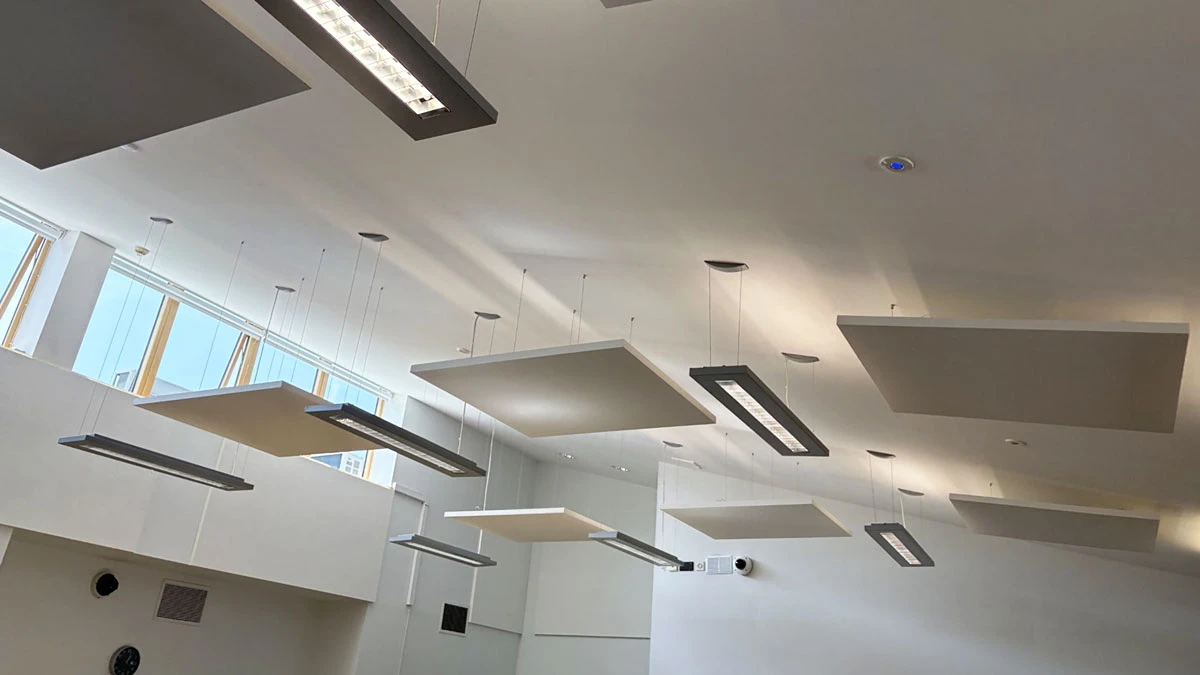
The installation comprised 900 m² of grooved acoustic wall panels, mounted on an air gap to significantly enhance sound absorption and overall acoustic performance. In addition, over 2,000 linear metres of linear Tundra ceiling baffles were installed to control reverberation within open and high-volume spaces.
Ryder Architecture
Overbury
Durham University’s transformation of the Waterside Building at Chancery Place into a state-of-the-art Business School reflects a strong commitment to sustainability, inclusivity and innovation.
Working closely with the client and the manufacturing team, a bespoke acoustic solution was developed using Autex Acoustics. This included the design and installation of custom teardrop-shaped ceiling baffles, carefully coordinated within the existing ceiling voids to maximise acoustic performance while creating a striking visual feature.
In addition, a varied selection of printed, grooved and Groove Duet wall panels was installed throughout the building, delivering effective sound absorption while adding texture and visual interest to key teaching and collaboration spaces.
The result is a distinctive, high-performing learning environment that supports modern education while making a strong architectural statement.
Talk to us about your acoustic goals — we’ll help you design a solution that sounds as good as it looks.




2026 © Style Group
HBN 00-09 sets out these surface characteristics because unsealed joints are a recognised place for moisture and micro-organisms to collect. A genuinely joint-free edge is designed to address that specific detail.
This is a surface and edge specification, not a clinical claim. Zero-joint technology has not been evaluated or certified by NHS England, and does not claim to reduce infection rates.
Food-service and guest-facing areas are typically inspected under hygiene and housekeeping standards that look closely at surfaces and joints. A seamless, moisture-resistant edge is designed with exactly that kind of scrutiny in mind.
Every one of these sectors shares the same underlying surface problem: a bonded-strip edge is a seam, and a seam is a place where dirt, moisture or wear can concentrate in a way a continuous surface can't. Zero-joint technology addresses that one structural detail across offices, schools, healthcare and hospitality settings alike — one construction detail, one shared weak point removed, four sectors that each care about it for their own reasons.
Fill in the form below and we’ll get back to you within one working day.
Fill in the form below and we’ll get back to you within one working day.
Fill in the form below and we'll get back to you as quickly as we can.
