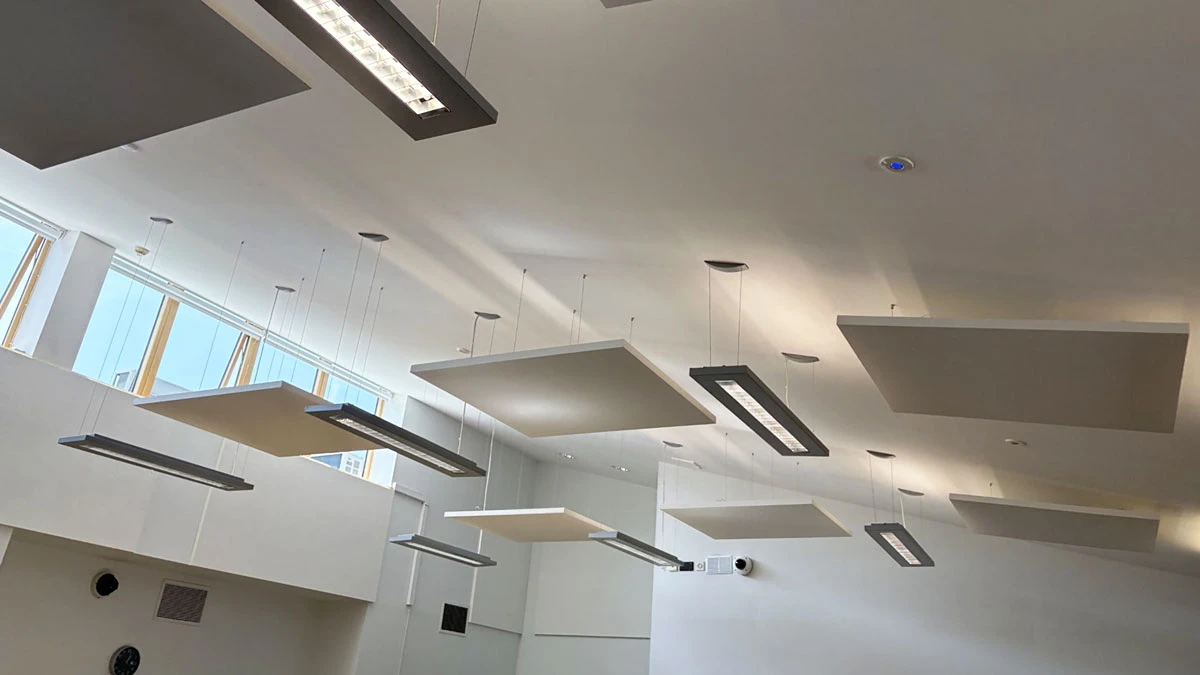
Improving acoustic clarity in a specialist healthcare environment


Founded in 1611, the School moved to its present magnificent 250 acre site near Godalming, Surrey in 1872. The School has around 800 pupils, all of whom, except for about 20 day pupils, are boarders. Working with architects, Design Engine, and subsequently in further detail direct with the client and contractor, SG & DJ Allison, […]
Founded in 1611, the School moved to its present magnificent 250 acre site near Godalming, Surrey in 1872. The School has around 800 pupils, all of whom, except for about 20 day pupils, are boarders.
Working with architects, Design Engine, and subsequently in further detail direct with the client and contractor, SG & DJ Allison, Style was specified to provide flexible space within the school’s ground floor central dining room, replacing an existing 30 year old partitioning wall as part of the solution.
DORMA Moveo, with its ComforTronic semi-automatic seals and 42dB Rw acoustics, was the ideal solution and, adapting to the curved contours of the building with angled elements Style created more space than the previous walls, plus maximum flexibility.
“At Charterhouse, the pupils dine amongst their peers from their boarding house,” said Julian Sargent, Style’s group managing director.
“For general meal times, we were therefore asked to create a flexible arrangement of 4 dining areas, but with the freedom to quickly open the entire room up into one very large dining room for special occasions and events.”
“DORMA Moveo is perfect in these occasions, as it’s highly versatile, lightweight, easy to manoeuvre and provides excellent acoustic separation. To complement the interior design, a cream laminate coating was chosen offering a clean, stylish finish.”
Talk to us about your acoustic goals — we’ll help you design a solution that sounds as good as it looks.



2026 © Style Group
HBN 00-09 sets out these surface characteristics because unsealed joints are a recognised place for moisture and micro-organisms to collect. A genuinely joint-free edge is designed to address that specific detail.
This is a surface and edge specification, not a clinical claim. Zero-joint technology has not been evaluated or certified by NHS England, and does not claim to reduce infection rates.
Food-service and guest-facing areas are typically inspected under hygiene and housekeeping standards that look closely at surfaces and joints. A seamless, moisture-resistant edge is designed with exactly that kind of scrutiny in mind.
Every one of these sectors shares the same underlying surface problem: a bonded-strip edge is a seam, and a seam is a place where dirt, moisture or wear can concentrate in a way a continuous surface can't. Zero-joint technology addresses that one structural detail across offices, schools, healthcare and hospitality settings alike — one construction detail, one shared weak point removed, four sectors that each care about it for their own reasons.
Fill in the form below and we’ll get back to you within one working day.
Fill in the form below and we’ll get back to you within one working day.
Fill in the form below and we'll get back to you as quickly as we can.
