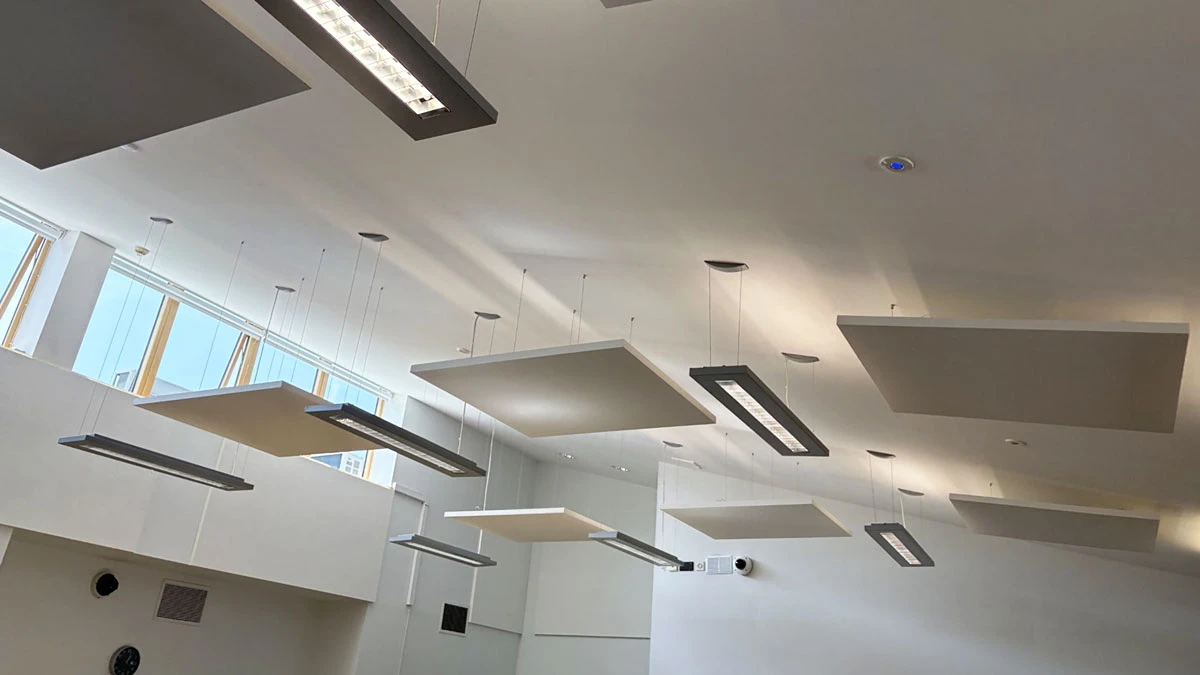
Improving acoustic clarity in a specialist healthcare environment


Sunesis is a joint venture between Scape Group and Willmott Dixon offering buildings delivered through an OJEU compliant framework to a tried and tested efficient process. Clients are able to choose a building model that best meets their needs, then personalise it according to their preferences and requirements. Flexible space is an important part of […]
Sunesis is a joint venture between Scape Group and Willmott Dixon offering buildings delivered through an OJEU compliant framework to a tried and tested efficient process. Clients are able to choose a building model that best meets their needs, then personalise it according to their preferences and requirements.
Flexible space is an important part of that personalisation process, and Sunesis customers benefit from the very best partitioning solution thanks to Style, who provide a DORMA Variflex moveable wall with a superb 55dB Rw acoustic rating.
The rapid design and construction process of Sunesis appealed to Derbyshire County Council, as did the versatile layout with a central ‘learning zone’ to provide a heart for the school. Air source heat pump supplies warmth to the entire building and in just 37 weeks the project was complete, providing Derby’s first school to see children through from 4-18 years.
“We’re delighted to be the chosen moveable wall partner for Willmot Dixon on such an innovative project,” said Mike Fine, Style’s director for the Midlands.
“DORMA Variflex is a superb product, and a key advantage for schools is that the panels are manufactured separately to the frame, making them easy to change if one is damaged or scuffed – a real benefit when there are so many children around!
“It’s also a hugely popular partitioning wall system that is simple to manoeuvre, enabling a room to be divided in two, or opened up completely, offering real flexibility in the way the space is used.”
Talk to us about your acoustic goals — we’ll help you design a solution that sounds as good as it looks.



2026 © Style Group
HBN 00-09 sets out these surface characteristics because unsealed joints are a recognised place for moisture and micro-organisms to collect. A genuinely joint-free edge is designed to address that specific detail.
This is a surface and edge specification, not a clinical claim. Zero-joint technology has not been evaluated or certified by NHS England, and does not claim to reduce infection rates.
Food-service and guest-facing areas are typically inspected under hygiene and housekeeping standards that look closely at surfaces and joints. A seamless, moisture-resistant edge is designed with exactly that kind of scrutiny in mind.
Every one of these sectors shares the same underlying surface problem: a bonded-strip edge is a seam, and a seam is a place where dirt, moisture or wear can concentrate in a way a continuous surface can't. Zero-joint technology addresses that one structural detail across offices, schools, healthcare and hospitality settings alike — one construction detail, one shared weak point removed, four sectors that each care about it for their own reasons.
Fill in the form below and we’ll get back to you within one working day.
Fill in the form below and we’ll get back to you within one working day.
Fill in the form below and we'll get back to you as quickly as we can.
