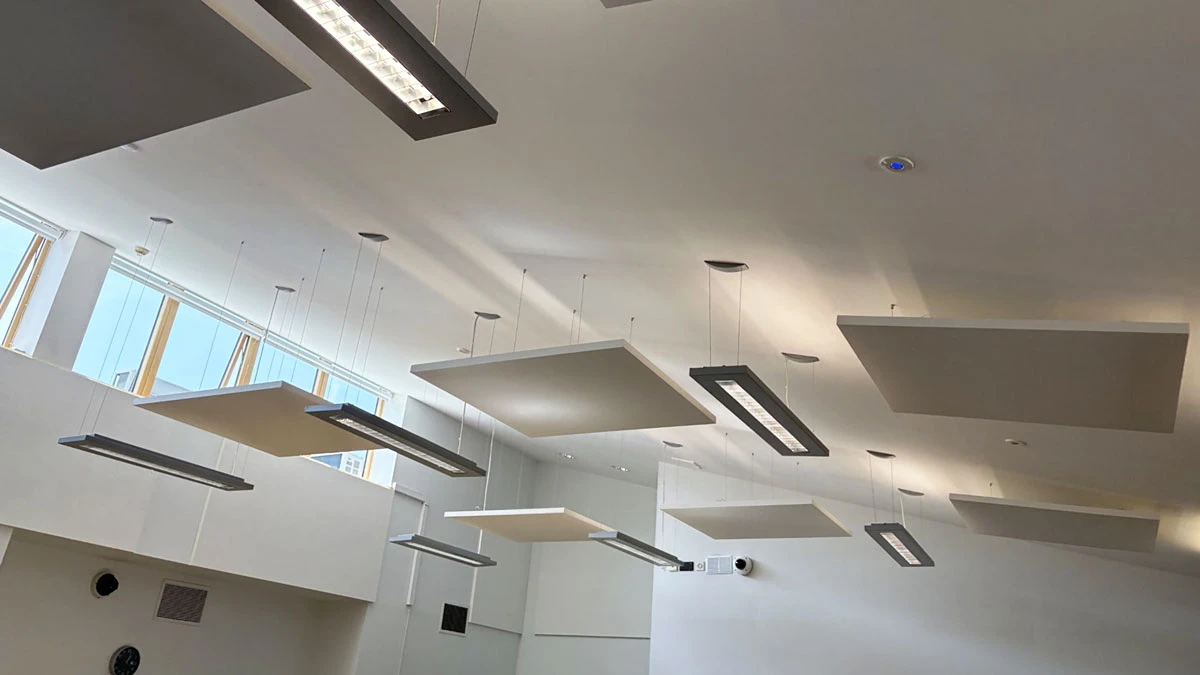
Improving acoustic clarity in a specialist healthcare environment


Working with architects, Pringle Brandon, and contractor, Overbury, Style was involved in this project – specified to create colourful, flexible space in the ground floor multifunction room. DORMA Variflex was selected as the most suitable option, with a stretched fabric finish and Kvadrat Steelcut Trio 2 colour 553 fabric, all in bright red to add […]
Working with architects, Pringle Brandon, and contractor, Overbury, Style was involved in this project – specified to create colourful, flexible space in the ground floor multifunction room.
DORMA Variflex was selected as the most suitable option, with a stretched fabric finish and Kvadrat Steelcut Trio 2 colour 553 fabric, all in bright red to add vibrancy to the room. With an outstanding 55dB acoustic rating, two walls were installed forming a ‘T’ shape, made up of 19 panels in total.
“It is always nice to be involved in an award-winning project,” said Julian Sargent, Style’s group managing director, “and we were delighted to see this building enjoy success in the BCO fit out category. Variflex is a tremendous moveable wall solution, and has the added advantage that its panels come separate to the frame. This enables a vast array of finishes to be added as they can be applied before installation.
“It also means if one of the panels is scuffed or damaged through use it can be replaced at the lowest possible cost, rather than impacting the integrity of the entire wall.
“In the case of Astella’s wall, the fabric can be removed from the panel relatively easily and a new fabric applied, making it the simplest change – for example, in case they wish to alter the colour at a later date.”
Variflex provides a wide choice of elements and stacking/parking arrangements. Its high level of flexibility means it is ideal for all scenarios, even in the case of complicated room proportions where sloping ceilings or circular spaces have to be accommodated.
Talk to us about your acoustic goals — we’ll help you design a solution that sounds as good as it looks.



2026 © Style Group
HBN 00-09 sets out these surface characteristics because unsealed joints are a recognised place for moisture and micro-organisms to collect. A genuinely joint-free edge is designed to address that specific detail.
This is a surface and edge specification, not a clinical claim. Zero-joint technology has not been evaluated or certified by NHS England, and does not claim to reduce infection rates.
Food-service and guest-facing areas are typically inspected under hygiene and housekeeping standards that look closely at surfaces and joints. A seamless, moisture-resistant edge is designed with exactly that kind of scrutiny in mind.
Every one of these sectors shares the same underlying surface problem: a bonded-strip edge is a seam, and a seam is a place where dirt, moisture or wear can concentrate in a way a continuous surface can't. Zero-joint technology addresses that one structural detail across offices, schools, healthcare and hospitality settings alike — one construction detail, one shared weak point removed, four sectors that each care about it for their own reasons.
Fill in the form below and we’ll get back to you within one working day.
Fill in the form below and we’ll get back to you within one working day.
Fill in the form below and we'll get back to you as quickly as we can.
