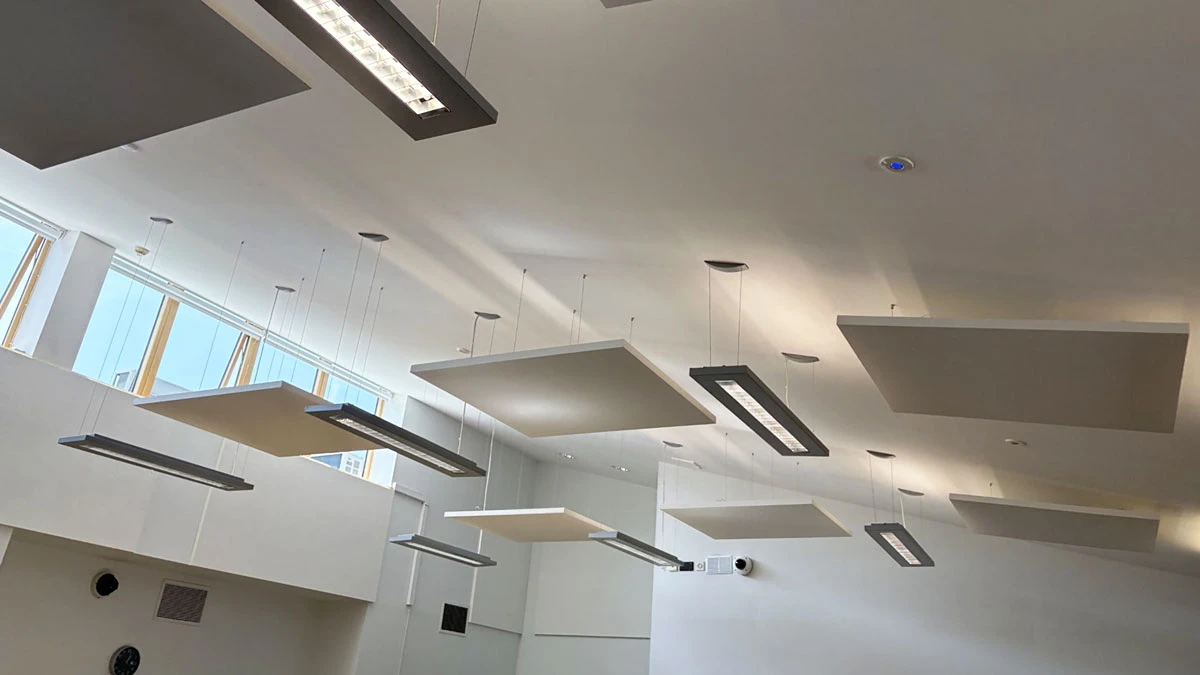
Improving acoustic clarity in a specialist healthcare environment


Working directly with Pattern at its London offices, Style was asked to provide a flexible and practical solution for the firm’s meeting rooms. DORMA Moveo was agreed as being the best solution, enabling the meeting area to be divided into two smaller rooms or opened up into one large space. With Pattern choosing a writable […]
Working directly with Pattern at its London offices, Style was asked to provide a flexible and practical solution for the firm’s meeting rooms.
DORMA Moveo was agreed as being the best solution, enabling the meeting area to be divided into two smaller rooms or opened up into one large space. With Pattern choosing a writable white board finish, the Moveo not only acts as a space divider, but also allows its architects to write up notes, action points and ideas during meetings.
“The white board finish has become extremely popular in meeting rooms,” said Julian Sargent, Style’s group managing director. “Moveo is also a hugely popular system for sub-dividing space because it incorporates ComforTronic® automatic seals as standard. These provide quicker operation and acoustic integrity of 55dB.
“Due to its very lightweight design, the additional advantage is that even large moving wall panels for high ceilings or large rooms are effortless to manoeuvre and they reduce the structural support requirements. To put this in context, a Moveo panel weighs up to 50% less than a conventional acoustic moveable wall, which is why it is so well-liked.”
Style is the exclusive UK partner to Dorma and, as well as offering an outstanding portfolio of moveable walls, the environmental credentials are second to none. Leading the way in sustainability, Moveo comes with an environmental product declaration (EPD) in accordance with ISO 14025 and EN 15804.
Talk to us about your acoustic goals — we’ll help you design a solution that sounds as good as it looks.



2026 © Style Group
HBN 00-09 sets out these surface characteristics because unsealed joints are a recognised place for moisture and micro-organisms to collect. A genuinely joint-free edge is designed to address that specific detail.
This is a surface and edge specification, not a clinical claim. Zero-joint technology has not been evaluated or certified by NHS England, and does not claim to reduce infection rates.
Food-service and guest-facing areas are typically inspected under hygiene and housekeeping standards that look closely at surfaces and joints. A seamless, moisture-resistant edge is designed with exactly that kind of scrutiny in mind.
Every one of these sectors shares the same underlying surface problem: a bonded-strip edge is a seam, and a seam is a place where dirt, moisture or wear can concentrate in a way a continuous surface can't. Zero-joint technology addresses that one structural detail across offices, schools, healthcare and hospitality settings alike — one construction detail, one shared weak point removed, four sectors that each care about it for their own reasons.
Fill in the form below and we’ll get back to you within one working day.
Fill in the form below and we’ll get back to you within one working day.
Fill in the form below and we'll get back to you as quickly as we can.
