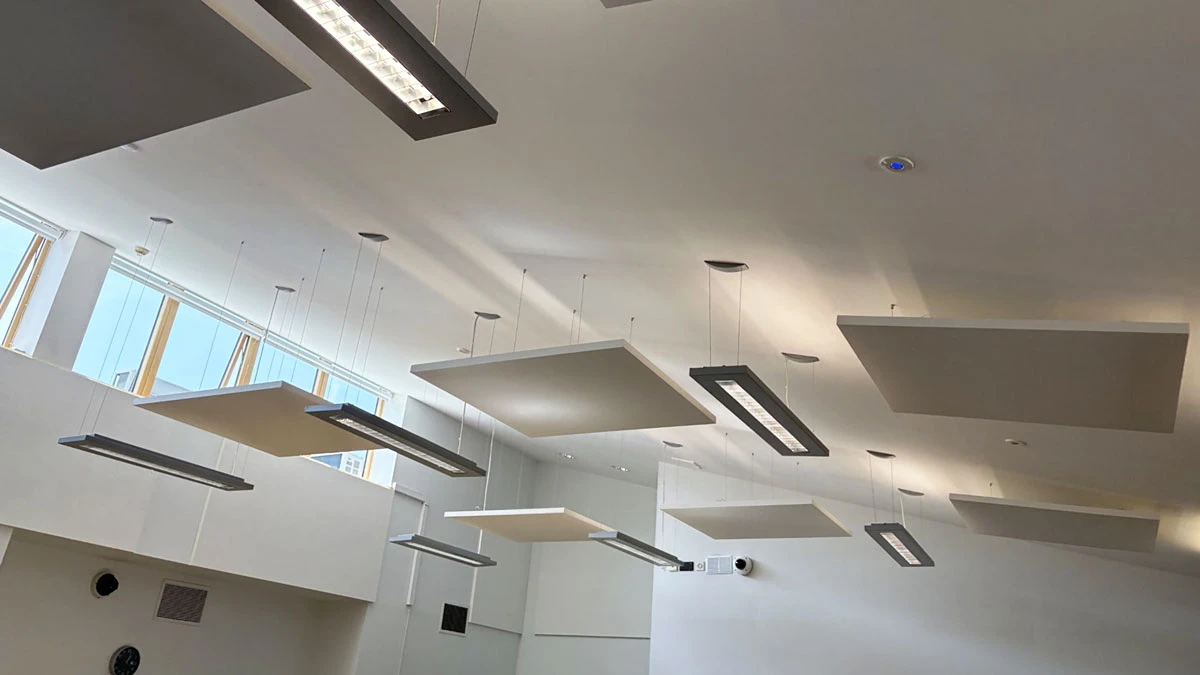
Improving acoustic clarity in a specialist healthcare environment


As a fully automatic, vertically operated moveable wall, Skyfold was identified as the ideal solution as it is stored in the ceiling cavity, therefore having no impact on floor space.
Future Space
Morris and Spottiswood
For the training rooms, creating flexible space was essential and Style was appointed by Future Space to work with Morris and Spottiswood.
The key criteria was that the space must be divided with speed and ease, and it also needed to offer crisp, clean lines, deliver acoustic performance and maximise the use of space by not having any pockets for the panels to be stored.
As a fully automatic, vertically operated moveable wall, Skyfold was identified as the ideal solution as it is stored in the ceiling cavity, therefore having no impact on floor space.
“Skyfold is a phenomenal solution for dividing space, and is also very stylish and offers exceptional ease of use through a simple turnkey operation,” said David Louden, Style’s Director for Scotland. “To complement the design of the building, we selected Skyfold Classic with a two-tone finish in silver and grey which looked amazing once in place.
“When using training rooms, privacy is important and the Skyfold product has a 56dB Rw rating, which is a very high specification. It can also be opened or closed in less than 2 minutes, which means the NFU can shut it in order to divide the space for breakout groups during a training course, and re-open it quickly to bring everyone back into the larger space.”
Ewan Stephen from Future Space added,
“We’ve worked with Style on many occasions and can always rely on them to offer a great solution. In this instance, we only had 16 weeks from concept to completion and they performed superbly to meet this tight deadline.”
Talk to us about your acoustic goals — we’ll help you design a solution that sounds as good as it looks.



2026 © Style Group
HBN 00-09 sets out these surface characteristics because unsealed joints are a recognised place for moisture and micro-organisms to collect. A genuinely joint-free edge is designed to address that specific detail.
This is a surface and edge specification, not a clinical claim. Zero-joint technology has not been evaluated or certified by NHS England, and does not claim to reduce infection rates.
Food-service and guest-facing areas are typically inspected under hygiene and housekeeping standards that look closely at surfaces and joints. A seamless, moisture-resistant edge is designed with exactly that kind of scrutiny in mind.
Every one of these sectors shares the same underlying surface problem: a bonded-strip edge is a seam, and a seam is a place where dirt, moisture or wear can concentrate in a way a continuous surface can't. Zero-joint technology addresses that one structural detail across offices, schools, healthcare and hospitality settings alike — one construction detail, one shared weak point removed, four sectors that each care about it for their own reasons.
Fill in the form below and we’ll get back to you within one working day.
Fill in the form below and we’ll get back to you within one working day.
Fill in the form below and we'll get back to you as quickly as we can.
