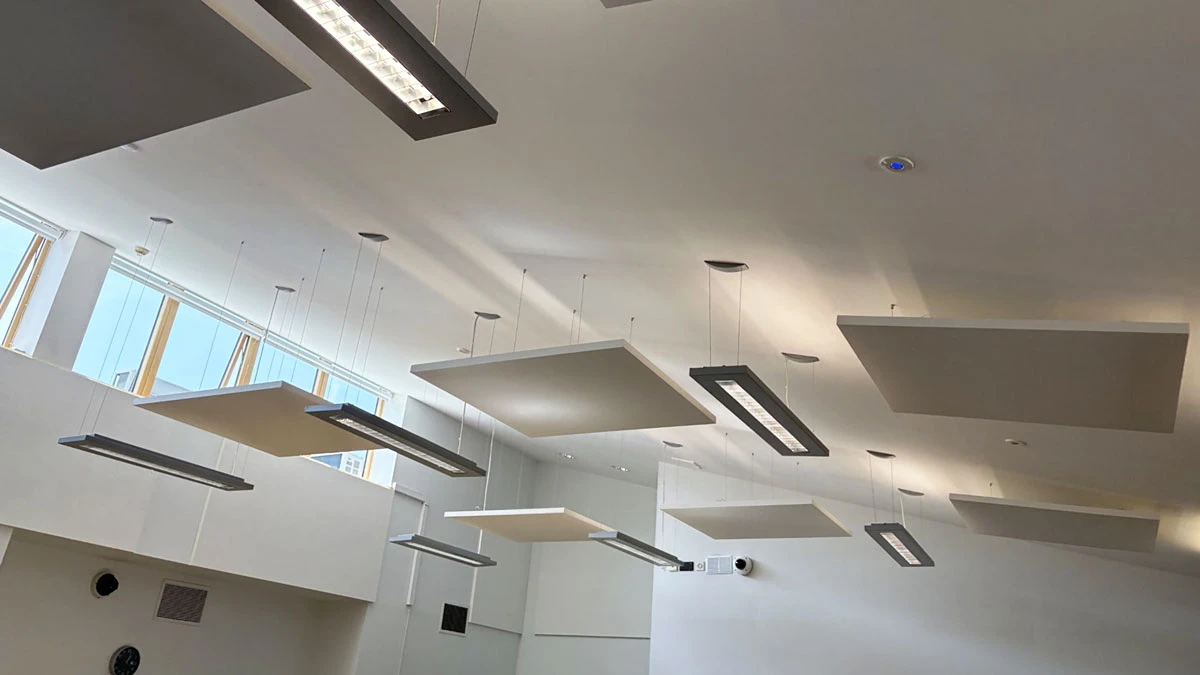
Improving acoustic clarity in a specialist healthcare environment


A Dorma Huppe Variflex glass moveable wall was installed with semi-automatic operation and a 52dB acoustic rating.
Dentons is the world’s largest law firm. Across over 80 countries, it helps grow, protect, operate and finance its clients’ organisations by providing uniquely global and deeply local legal solutions. Polycentric, purpose-driven and committed to inclusion and sustainability, it focuses on what matters most to each client.
At Dentons’ offices in Milton Keynes, Style worked with contractor, CBRE, to install an additional moveable wall to convert an existing corner moveable wall into a “T” configuration.
A Dorma Huppe Variflex glass moveable wall was installed with semi-automatic operation and a 52dB acoustic rating.
This new ‘extension’ increased the flexibility of the office space by giving Dentons the option to create an additional small meeting room, create a much bigger meeting area, or open up the entire floorspace for larger gatherings.
Offering seamless interior design, the frames of the new moveable wall were matched to those of the existing wall, with a continuation of the glass and a pass door for ease of access.
“This is a great example of where flexible meeting space is working so well that a client requires even more adaptability,” said Michael Porter, Style’s group managing director.
“The high end acoustic rating of this Variflex moveable wall means meetings can take place in complete privacy, without noise disturbance, and the semi-automatic operation means the acoustic seals are applied to the correct pressure each time the wall is closed.
“In addition, this is a highly sustainable solution as it is an EPD certified moveable wall in accordance with ISO 14025 and EN15804. This is of importance to anyone seeking sustainable solutions for BREEAM, LEED or SKA.”
Talk to us about your acoustic goals — we’ll help you design a solution that sounds as good as it looks.



2026 © Style Group
HBN 00-09 sets out these surface characteristics because unsealed joints are a recognised place for moisture and micro-organisms to collect. A genuinely joint-free edge is designed to address that specific detail.
This is a surface and edge specification, not a clinical claim. Zero-joint technology has not been evaluated or certified by NHS England, and does not claim to reduce infection rates.
Food-service and guest-facing areas are typically inspected under hygiene and housekeeping standards that look closely at surfaces and joints. A seamless, moisture-resistant edge is designed with exactly that kind of scrutiny in mind.
Every one of these sectors shares the same underlying surface problem: a bonded-strip edge is a seam, and a seam is a place where dirt, moisture or wear can concentrate in a way a continuous surface can't. Zero-joint technology addresses that one structural detail across offices, schools, healthcare and hospitality settings alike — one construction detail, one shared weak point removed, four sectors that each care about it for their own reasons.
Fill in the form below and we’ll get back to you within one working day.
Fill in the form below and we’ll get back to you within one working day.
Fill in the form below and we'll get back to you as quickly as we can.
