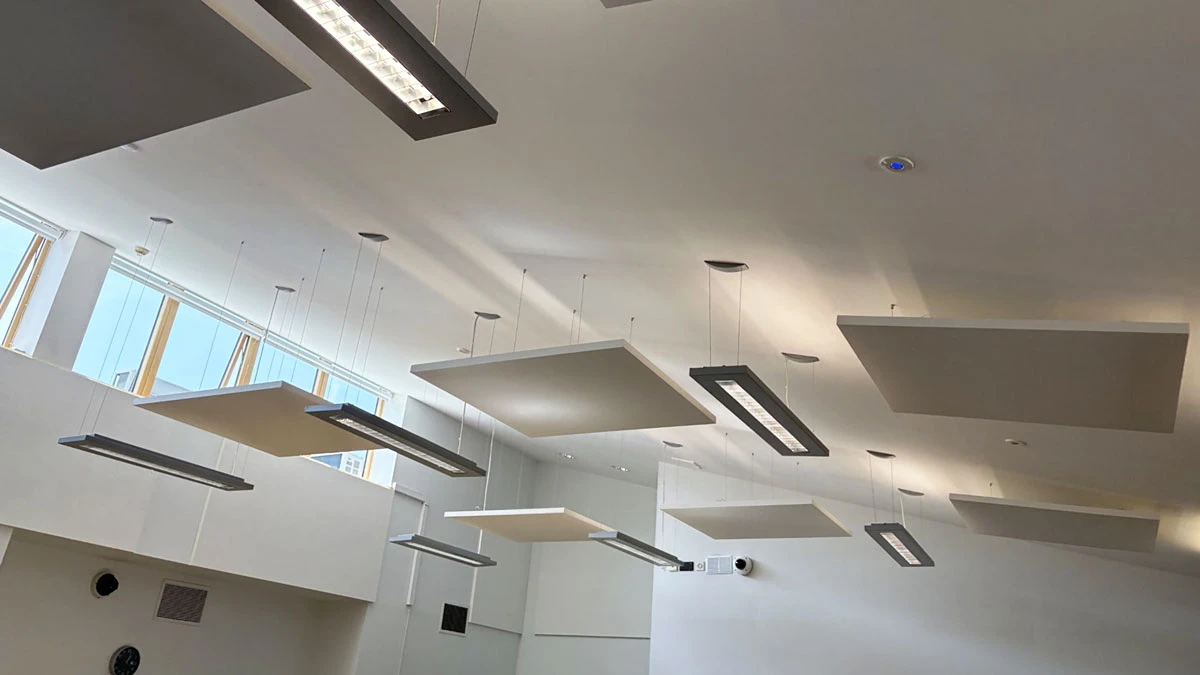
Improving acoustic clarity in a specialist healthcare environment


DBRS became the first UK company to choose a DORMA Moveo moveable wall with ‘Magic Glass’ – the ingenious ‘clear to opaque’ solution that offers privacy at the push of a button.
Formed in 1976, DBRS is a globally recognised provider of timely credit rating opinions. Headquartered in Toronto, the company has offices in New York, Chicago and London, recently moving into the 31st floor of 20 Fenchuch Street, better known as the Walkie Talkie building.
Working with Originate Architects and main contractors, Parkeray, Style was specified to create flexible space, which for this installation had a very special feature.
DBRS became the first UK company to choose a DORMA Moveo moveable wall with ‘Magic Glass’ – the ingenious ‘clear to opaque’ solution that offers privacy at the push of a button.
DORMA Hüppe’s new Magic Glass extends the number of applications for a moveable wall. Not only can open plan space be sub-divided into smaller private rooms, this additional feature means you can choose the level of privacy too. The effect is created by liquid crystals which change from transparent to opaque through an electric current.
“Magic glass is a superb new addition to the wide-ranging benefits of Moveo,” said Julian Sargent, Style’s group managing director. “When the wall is in place, if you’re looking for light and visibility it’s a stunning glass partitioning wall.
“Yet, if privacy is required, the wall turns into a milky opaque glass element at the flick of a wall-mounted, or remote control, switch.”
“The 50dB Rw acoustics ensure DBRS can conduct meetings in privacy,” continued Julian, “but the magic glass adds another level of confidentiality by stopping anyone seeing into the room too.
“This is an extremely exciting development to DORMA’s glass range and we’re expecting huge demand from a diverse cross section of sectors including healthcare, education, hospitality and corporate.”
Style is the exclusive UK partner to DORMA, Skyfold and SWG. Skyfold was also installed at DBRS offering a breathtaking final solution.
Talk to us about your acoustic goals — we’ll help you design a solution that sounds as good as it looks.



2026 © Style Group
HBN 00-09 sets out these surface characteristics because unsealed joints are a recognised place for moisture and micro-organisms to collect. A genuinely joint-free edge is designed to address that specific detail.
This is a surface and edge specification, not a clinical claim. Zero-joint technology has not been evaluated or certified by NHS England, and does not claim to reduce infection rates.
Food-service and guest-facing areas are typically inspected under hygiene and housekeeping standards that look closely at surfaces and joints. A seamless, moisture-resistant edge is designed with exactly that kind of scrutiny in mind.
Every one of these sectors shares the same underlying surface problem: a bonded-strip edge is a seam, and a seam is a place where dirt, moisture or wear can concentrate in a way a continuous surface can't. Zero-joint technology addresses that one structural detail across offices, schools, healthcare and hospitality settings alike — one construction detail, one shared weak point removed, four sectors that each care about it for their own reasons.
Fill in the form below and we’ll get back to you within one working day.
Fill in the form below and we’ll get back to you within one working day.
Fill in the form below and we'll get back to you as quickly as we can.
