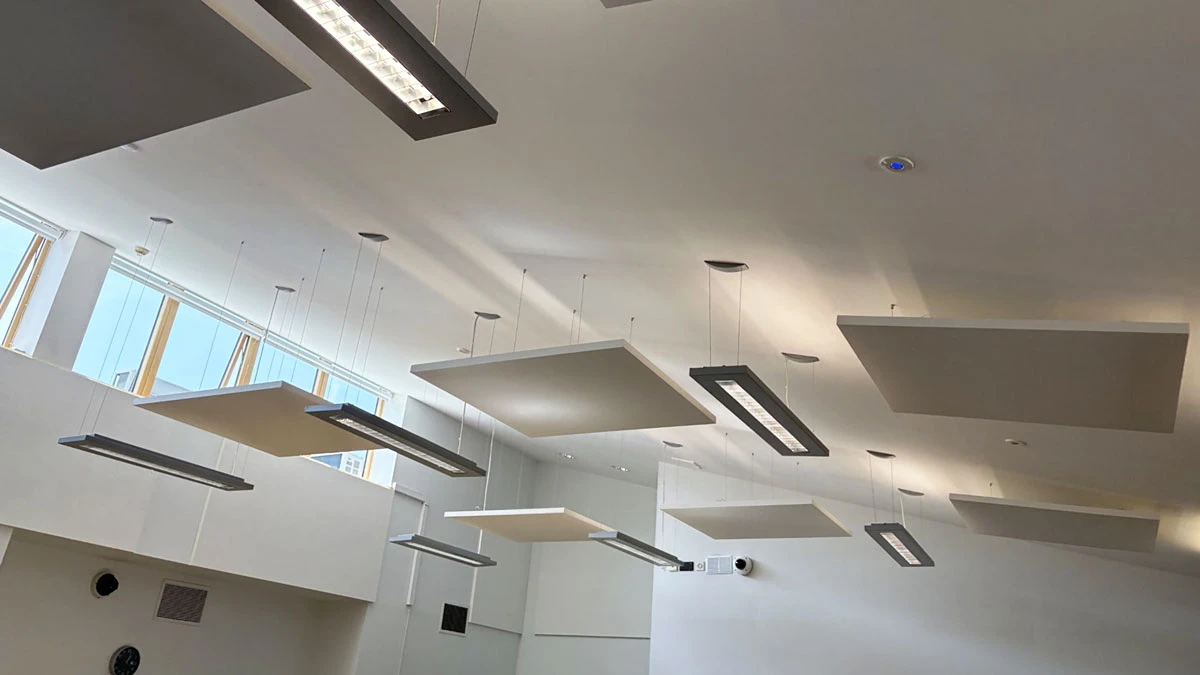
Improving acoustic clarity in a specialist healthcare environment


The working walls, installed within the Innovation Centre, offered the freedom to divide off the space in a variety of configurations – either offering a temporary wall or individual screens.
Finished in a blue painted glass these working walls are becoming increasingly popular for breakout areas, collaborative workspace and informal brainstorming areas.
Seen as the “bank of banks,” The Bank of New York Mellon Corporation, commonly known as BNY Mellon, powers the financial industry having been formed from the merger of The Bank of New York and the Mellon Financial Corporation in 2007. It is the world’s largest custodian bank and asset servicing company, with $2.2 trillion in assets under management and $41.7 trillion in assets under custody as of the second quarter of 2021.
Working with architects, T P Bennett and contractors ISG, Style was specified to create flexible space at BNY Mellon’s London offices using a blend of solid moveable walls, glass moveable walls and Style’s unique and innovative working walls – designed for agile, collaborative space.
The working walls, installed within the Innovation Centre, offered the freedom to divide off the space in a variety of configurations – either offering a temporary wall or individual screens.
Finished in a blue painted glass these working walls are becoming increasingly popular for breakout areas, collaborative workspace and informal brainstorming areas.
In the Thames Room (a meeting room named after its stunning views of the river) a large C-shaped Dorma Huppe Variflex glass moveable wall was installed offering 52dB acoustics, fully glazed pass doors and a stylish crittall effect.
In the other meeting areas, a 59dB semi-automatic Dorma Huppe Variflex solid moveable wall was installed with chic, fabric wrapped panels. This abutted to a fixed glass wall that matched the crittall effect of the other Variflex glass providing seamless interior design.
“This is a great example of using various types of moveable and working walls to give different types of flexibility in various meeting areas and collaboration zones,” said Michael Porter, sales director at Style South.
“It also highlights Style’s key strengths in the market in terms of our working walls and fully glazed pass doors, which are unrivalled and highly unique.”
Click here for more information about Glass Moveable Walls
Talk to us about your acoustic goals — we’ll help you design a solution that sounds as good as it looks.



2026 © Style Group
HBN 00-09 sets out these surface characteristics because unsealed joints are a recognised place for moisture and micro-organisms to collect. A genuinely joint-free edge is designed to address that specific detail.
This is a surface and edge specification, not a clinical claim. Zero-joint technology has not been evaluated or certified by NHS England, and does not claim to reduce infection rates.
Food-service and guest-facing areas are typically inspected under hygiene and housekeeping standards that look closely at surfaces and joints. A seamless, moisture-resistant edge is designed with exactly that kind of scrutiny in mind.
Every one of these sectors shares the same underlying surface problem: a bonded-strip edge is a seam, and a seam is a place where dirt, moisture or wear can concentrate in a way a continuous surface can't. Zero-joint technology addresses that one structural detail across offices, schools, healthcare and hospitality settings alike — one construction detail, one shared weak point removed, four sectors that each care about it for their own reasons.
Fill in the form below and we’ll get back to you within one working day.
Fill in the form below and we’ll get back to you within one working day.
Fill in the form below and we'll get back to you as quickly as we can.
